
Water Intrusion: Why Transitions Between Siding and Masonry Deserve a Closer Look
- Anne Y.
- Apr 21
- 4 min read
Water intrusion rarely announces itself at the point of entry. In townhomes and condominium buildings, it often travels quietly behind finishes revealing itself only after damage has already begun. While leaks can stem from many causes, one of the most common and overlooked problem areas we encounter is the transition between siding and brick or stone veneers.

Understanding how these assemblies are meant to work, and how they fail, can make all the difference in protecting your community’s buildings and budgets.
The Many Causes of Water Intrusion
Community associations face unique building envelope challenges. Repeated building designs, shared walls, and complex exterior details mean that one small weakness can affect multiple units.
Water intrusion is typically linked to:
Aging materials and UV degradation
Freeze/thaw cycles and wind-driven rain
Installation deficiencies (missing flashing, improper WRB integration)
Deferred sealant and coating maintenance
Complex rooflines and architectural transitions
Blocked drainage paths or missing weeps
Improper roof-to-wall details (including missing kick-out flashing)
While all these factors matter, material transitions, especially where siding meets brick or stone veneer, consistently rise to the top during our investigations.
“Water doesn’t have to pour in to cause damage. Even small, repeated intrusion at material transitions can create significant concealed deterioration over time.”
Why Siding-to-Masonry Transitions Are Vulnerable
Transitions between different cladding materials are high-risk because they bring together components that expand, contract, and shed water differently.
Siding and masonry veneer behave differently under temperature changes and moisture exposure. If the layers behind them; flashing, weather-resistive barriers (WRB), and drainage paths are not properly integrated, water will find the path of least resistance.
These assemblies are not meant to rely solely on surface caulk. They are designed to:
Collect water that gets behind cladding
Direct it outward with flashing
Drain it safely through weeps or exit points
When one of those layers is missing or improperly installed, water can migrate into sheathing, framing, and insulation.
“Sealant is maintenance, not structure. If flashing and drainage aren’t properly integrated,
recaulking alone won’t solve the problem.”

No flashing where the siding meets the facade capstones.
Photo: InterNACHI

Flashing visible from underneath the plank siding and onto the top of the capstone.
Photo: InterNACHI
What We Commonly Find at These Transitions
During inspections in townhomes and condominium communities, we often encounter:
1. Missing or Improper Through-Wall Flashing: Without proper flashing and end dams at
veneer transitions, moisture can accumulate behind brick or stone and move inward.
2. Poor WRB Integration: Reverse laps or improperly terminated barriers can funnel water
directly into wall assemblies.
3. Over-Reliance on Caulk: Surface sealant joints deteriorate with UV exposure and
movement. When they are the primary defense, failure is inevitable.
4. Differential Movement Between Materials: Rigid trim details can “lock” materials
together, causing joints to crack as siding and masonry move differently.
5. Missing Kick-Out Flashing at Roof Intersections: Water originating above the transition
often migrates downward, appearing as a wall issue when the true source is higher.
6. Blocked Weep Paths: Brick and stone veneer systems require drainage. When weeps
are painted over, clogged, or missing, moisture becomes trapped.
How Water Intrusion Shows Up Inside Units
Because water travels, interior symptoms don’t always align with the entry point. Common indicators include:
Bubbling paint or peeling drywall
Staining near baseboards or ceiling lines
Musty odors after heavy rain
Warped trim or flooring
Recurring issues in similar units or elevations
In community associations, patterns matter. If one building section shows symptoms, others with identical construction details may be at similar risk.
“One unit’s leak can be a building-wide signal, not an isolated incident.”

Bubbling paint on drywall
Photo: Stack Exchange

Warped trim or flooring
Photo: 1-Tom-Plumber
The Role of Invasive Inspections
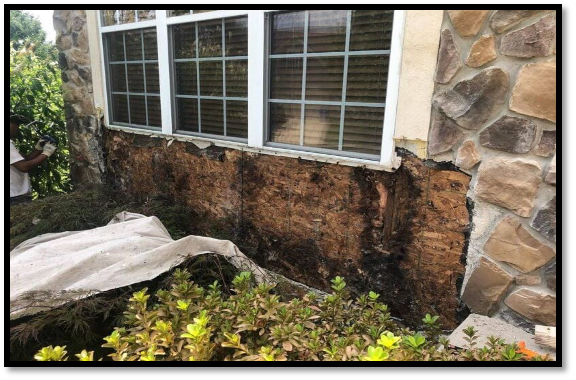
Visual inspections and moisture scanning are valuable first steps. However, when recurring leaks or concealed conditions are suspected, targeted invasive inspection may be necessary.
This can include:
Strategic openings at material transitions
Borescope verification behind cladding
Confirmation of flashing and WRB continuity
Documentation of concealed deterioration
When done carefully and strategically, invasive inspection removes uncertainty. It confirms how the assembly is truly constructed, not just how it appears from the exterior.
“Understanding what’s happening behind the wall is often the most cost-effective step toward long-term resolution.”

Photo: ProStone
When Collaboration with an Engineer Is Important
Depending on findings, when moisture intrusion appears systemic or structural components may be compromised, a more invasive inspection may be warranted. Depending on severity, that process should include collaboration with a qualified engineering firm, particularly when:
Structural deterioration is present, impacts to framing, sheathing, and steel components
Failures appear systemic across multiple buildings
Complex building envelope interfaces are involved
Stamped repair details are required
Documentation must meet legal or insurance standards
Their assessment ensures that remediation addresses not only the symptom, but the full extent of underlying conditions
Engineering support helps translate field findings into durable repair solutions and long-term corrective strategies.
Experience Matters
For more than 30 years, the team at Advance Home Pros has worked within community associations throughout New Jersey and Pennsylvania, diagnosing and resolving complex building envelope challenges. We’ve seen firsthand how often water intrusion originates at transitions, especially where siding meets brick or stone veneer and how quickly small weaknesses can become larger, more expensive problems when they’re not diagnosed correctly.
Our approach is investigative first. We test methodically. We isolate the source. We identify root causes before recommending solutions. In architecturally detailed and luxury communities especially, precision and clarity matter.
Building envelope failures can sometimes extend beyond visible materials. Having the right professionals involved early protects the association’s long-term financial and structural interests. It’s not just about fixing what’s visible. It’s about understanding what’s happening behind the wall and solving the problem for the long term.
Our goal is simple. Protect the integrity of your buildings, preserve your reserve investments, and provide boards and managers with confidence in every decision, including knowing when to bring additional expertise to the table.
If your community experienced recurring or mystery leaks this winter, repeated caulk failures, or interior symptoms that don’t match obvious exterior defects, a building envelope review in early spring is the ideal time to evaluate before minor conditions evolve into larger capital projects.
We take pride in helping communities maintain comfort, confidence, and long‑term performance. Whether through inspections, maintenance planning, capital‑improvement coordination, or guidance for future projects, our mission is always rooted in protecting what matters most, so your community continues to feel like home.

Where Strong Communities Start
Servicing New Jersey & Pennsylvania
Direct: 609.578.4178


Comments